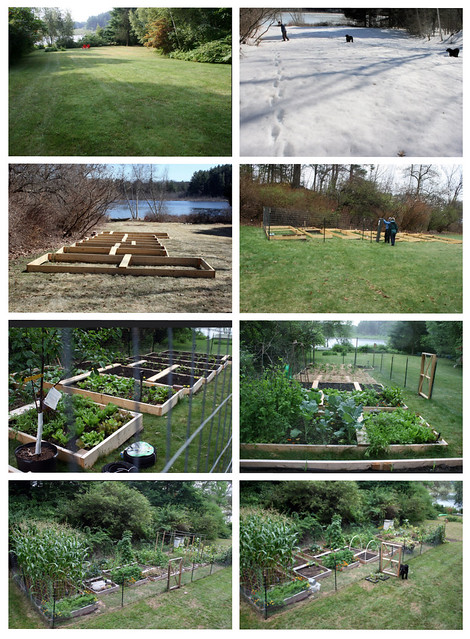
And I've been watching the snow melt on the spot where I'd like to put my new home garden. There is a very slight slope there too, facing south. Also tall trees all around the open yard. The snow melts fastest at the top of the slope, which is right along the south facing tree line. I'll put my garden in this spot.
Saturday, 31 January 2015
watching how the snow thaws
And I've been watching the snow melt on the spot where I'd like to put my new home garden. There is a very slight slope there too, facing south. Also tall trees all around the open yard. The snow melts fastest at the top of the slope, which is right along the south facing tree line. I'll put my garden in this spot.
Friday, 30 January 2015
January snow drop
planning early for late blight
We had such a bad time with late blight at our community garden last year. This year we will be distributing late blight resistant tomatoes to any of our gardeners who want to give them a try. We have contracted to have 500 seedlings grown for us. They will be grown locally by Sandra at Underwood Greenhouses, a old greenhouse (circa 1905) in Belmont.
Sandra has purchased all of the seeds and is planning to begin planting in March (I think). I am looking forward to photographing the process. I can't wait to see all those little tomato plants growing.
Here is our late blight resistant variety list:
Defiant PhR (Johnny's Seed)
Mountain Magic (Johnny's Seed)
Plum Regal (Johnny's Seed)
Legend (Reimer Seeds)
Old Brooks (Reimer Seeds)
Sun Gold (Johnny's Seed)
I tried to find a source for Ferline (Thompson and Morgan) that will ship to the US, but haven't been able to.
Sandra will also grow some heirloom tomatoes for us. The Brandywine variety is one she and her father have saved for 50 years. These varieties will not be resistant to late blight. For them, I am thinking of trying a plastic.tunnel. I suppose it would need to be about 5 feet tall. I am just beginning to look into where I would buy one of these. A tunnel would keep moisture off of the plant's leaves.
Here is the list of heirlooms being grown for us:
Brandywine (saved seeds)
Cherokee Purple (Johnny's)
Gold Medal (Reimer)
Cosmonaut Volkov (Territorial)
San Marzano Gigante (Territorial)
Prudens Purple (Johnny's)
Mortgage Lifter (Reimer)
Tiffen Mennonite (Reimer)
Purple Calabash (Territorial)
Moskvich (Johnny's)
I have also been reading about grafted tomatoes (article on grafted tomatoes at almanac.com). It seems if you graft a nice delicate heirloom onto a tough resistant root stock, the heirloom will take on some characteristics of the root stock. You still get heirloom tomatoes but the plant is more vigorous and has more disease resistance. Territorial is selling some grafted Brandywines. I might try this too, just to compare. And, if I get time, I'd like to look into what is involved in grafting my own plants.
I am sure Sandra will be growing extra plants, so these varieties should be available for other gardeners too. I think you can contact her through her website, Underwood Greenhouses,, if you ant to make sure.
Sandra has purchased all of the seeds and is planning to begin planting in March (I think). I am looking forward to photographing the process. I can't wait to see all those little tomato plants growing.
Here is our late blight resistant variety list:
Defiant PhR (Johnny's Seed)
Mountain Magic (Johnny's Seed)
Plum Regal (Johnny's Seed)
Legend (Reimer Seeds)
Old Brooks (Reimer Seeds)
Sun Gold (Johnny's Seed)
I tried to find a source for Ferline (Thompson and Morgan) that will ship to the US, but haven't been able to.
Sandra will also grow some heirloom tomatoes for us. The Brandywine variety is one she and her father have saved for 50 years. These varieties will not be resistant to late blight. For them, I am thinking of trying a plastic.tunnel. I suppose it would need to be about 5 feet tall. I am just beginning to look into where I would buy one of these. A tunnel would keep moisture off of the plant's leaves.
Here is the list of heirlooms being grown for us:
Brandywine (saved seeds)
Cherokee Purple (Johnny's)
Gold Medal (Reimer)
Cosmonaut Volkov (Territorial)
San Marzano Gigante (Territorial)
Prudens Purple (Johnny's)
Mortgage Lifter (Reimer)
Tiffen Mennonite (Reimer)
Purple Calabash (Territorial)
Moskvich (Johnny's)
I have also been reading about grafted tomatoes (article on grafted tomatoes at almanac.com). It seems if you graft a nice delicate heirloom onto a tough resistant root stock, the heirloom will take on some characteristics of the root stock. You still get heirloom tomatoes but the plant is more vigorous and has more disease resistance. Territorial is selling some grafted Brandywines. I might try this too, just to compare. And, if I get time, I'd like to look into what is involved in grafting my own plants.
I am sure Sandra will be growing extra plants, so these varieties should be available for other gardeners too. I think you can contact her through her website, Underwood Greenhouses,, if you ant to make sure.
Thursday, 29 January 2015
four eggs so far
Both Ginger and Penny laid another egg today. Omelets on the menu here for the weekend. I'm looking forward to comparing the fresh eggs to store bought eggs. I've been told they are much better.
frozen whiskers
The little creek by the gardens is freezing over. Skippy loves to drink the icy water. He ends up with icicles hanging from his whiskers that stay there for the rest of our walk.
frozen garden plot
I haven't even opened the gate in a couple months now. Everything is frozen and drab.
I'm glad I was able to put a good layer of hay down as this winter has been brutal for the overwintering plants. We've had wide swing in temperatures and very little snow cover.
Somewhere under the hay is 100 garlic shoots, a 4 year old bed of asparagus, a clump of Egyptian walking onions, a big crown of rhubarb, a few strawberry and raspberry plants, roots from my two espaliered pear trees, and a bunch of perennial flowers.
Amazingly enough, the walking onions still look green.
Wednesday, 28 January 2015
another egg
seed catalogs
I have a stack of catalogs and have been reading through them all. They're as good as a nice novel! Its exciting that there is so much to plan.
I've been reading the pages on organic pest control in Johnny's catalog. I've circled a bunch of onion and leek varieties the Fedco catalog. And I've circled eggplants, peppers and a lovely pink sweet pea in the Cook's catalog.
The first seeds I plant are always onions, leeks and celeries. I used my planting calendar tool to print out a list of the dates to start these. It says I should start planting on Feb 22. I am thinking I will start a few 6-packs a bit early. I bought the last 3 planting trays from last season at my local hardware store this weekend, as well as some 6-pack inserts, so I am all set. Maybe today? Why not.....
new ad
I have a new ad posted from Mike the Gardener. You may want to check out his site. Here's the link: Seeds of the Month Club .
Tuesday, 27 January 2015
an egg!!! an egg!!!
I was busy all day today and, for the first time, didn't get out to the coop until very late. It was about 7 pm and dark, but the coop light was still on. The hens muttered as I came up, something about "where have you been" and "why didn't you bring us our leftovers this morning" or maybe it was more like "we're really glad to see you".
Anyway, they clucked and baaked and I did the usual check of the coop and THERE IT WAS! I've looked for an egg at least once a day since the end of November. I hardly knew what I was seeing.
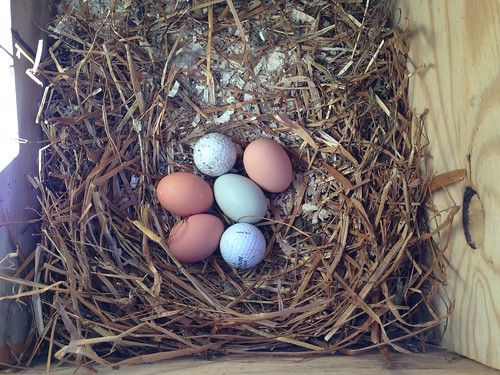
Its a pale blueish-greenish egg - that would be one of Ginger's. She's an Araucana chicken. My brown hen. (My other two hens will eventually lay brown eggs.) Its a lot smaller than the extra-large store-bought eggs I had in the fridge.
I found the egg lying in the middle of the hen house, almost buried in the extra deep layer of fresh wood shavings and hay I put down a couple days ago. I'll have to tell Ginger she's supposed to lay in one of the nesting boxes. That's OK, I can work on explaining that to her now that she's an official "laying hen"!
I'll make sure to bring all the hens a special breakfast tomorrow!
draft 2 of my new 2014 garden
Lots of room for tomatoes - I'm looking forward to canning enough the last the winter next year. Same with potatoes - I'll have enough room to grow baskets of potatoes for storage all winter. Lots of room for greens, spinach, lettuce, mustards, arugula, and bok choy. Room for green beans, soy beans and shell beans. Even space for cutting flowers, mostly zinnias and small sunflowers, I think.
Since I planted my garlic in my community garden plot last fall, I'll keep that garden too this year. My espaliered pears are there. This fall I'll move them to my backyard. I've planned to put crops that need less attention in my community plot. (I'm also the Garden Coordinator for at least another year, so I'd like to spend time there to keep up with how things are going.)
So I'll be busy in the garden this year!!! What fun.
Monday, 26 January 2015
plant shelves are up!
Sunday, 25 January 2015
january larder
I have a good supply of garlic - I got that crop in the ground before we started the home-selling stuff. Its really nice, with big cloves and holding fine (even though we don't have a cool place to store it - that's another story: our new house doesn't have a basement yet. We'll build one this spring.)
I also have a couple nice shallots left. (I grew shallots for the first time last year and was really pleased with these. I'll grow them again this year.) I have a lot of dried chilis. I grow a cayenne and a Thai hot chili every year. These thin-walled chilis air dry easily on a plate my counter top. I also have a couple bags of dried herbs. These are plants I cropped short when we left our old house. I have dill, sage and oregano.
And I have a little bowlful of dried beans. I tried to grow crops of Jacobs Cattle beans and black turtle beans, but only ended few of the former. And, then I grew Fortex green beans, but didn't harvest them in time so they matured and dried. So I have a fairly unattractive and very small bowl of dried beans. Nevertheless, I'm saving them and looking forward to a special chili meal.
cold cold frame
Friday, 23 January 2015
bitter cold
The remote thermometer inside my cold frame says 6*F (-14*C). Brrr! I've never seen such a low reading. I suppose the greens will not survive.
Inside my house it is warmer. I just made pumpkin bread (my pumpkin bread recipe link) using buttercup squash. Such amazing flavor. I am thinking I should compare pumpkin and squash side-by-side in this recipe someday. I think pumpkin is sweeter and milder and squash is very squashy and rich.
Tuesday, 20 January 2015
saving seeds
Each year I try to save one or two more types of seeds. For a few years now, I've saved Chinese pole beans, cayenne and Thai hot peppers. I sprouted my own sweet potatoes and garlic. For this year, I have also saved seeds from red runner beans, buttercup squash, and a mix of nasturtiums.
Saving seeds is Free! You to gradually improve the variety so that it becomes adapted to your garden conditions. And you save all the resources that would have gone into the packaging, shipping and selling of the seeds.
It's easiest to save seeds from fruit-producing crops that tend not to cross pollinate. This includes beans, peppers, eggplants, and tomatoes. Squashes will cross pollinate if different varieties they are grown close by each other. (I grow buttercup and butternut squashes together, but I got such fantastic sweet squash from a volunteer buttercup last year that I am saving its seeds this year. Maybe I will end up with a crossed variety someday.)
I've never saved seeds from a crop that doesn't produce fruit. Maybe this year would be a good time to try. This would include broccoli, kale, cabbages, lettuces and other greens, herbs like cilantro and basil, and roots like beets, carrots and onions. We don't usually let the crops flower and go to seeds, but it's quite easy to get lettuce and cabbages to bolt in mid summer. They make pretty yellow or white flowers that will eventually hold the seeds. I think the root vegetables are usually biennial and will go to seed if they are left in the ground a second year. Parsley is a biennial too. I always let my parsley grow two years, but I cut off the flower stalks. This is a seed I could start to save.
I'm still going over my crops from last year and recording how they did. When I finish I will pick a couple of my favorites and put them on my seed saving list for next year.
Last fall I made a video on how to save seeds for E-How. Here's the link.
Monday, 19 January 2015
chickens don't like the snow - but Suzie LOVES it
(you'd think they could at least lay eggs while they're in there - no eggs yet)
Sunday, 18 January 2015
snow on my future garden
Saturday, 17 January 2015
Friday, 16 January 2015
fox!!
A red fox walked through my backyard today not 20 feet from the window where I was. It was heading toward the chicken coop. I wish I'd gotten a picture as it was a beautiful animal, but I jumped up and ran yelling "Stay away from my chickens!"
Now that the local wildlife has found my hens, I'm wondering now if I should add that layer of chicken wire I'd been meaning to add at the base of the run to protect against digging predators.
The main predator of chickens that I've heard of around here is hawks. Red tailed hawks are big, but I don't know if one could fly off with a chicken. A friend of mine had a hawk get into her run's open door this winter and drag off a chicken. (I'll have to ask her if it was a full sized hen or a bantam.) I don't think it flew off with the hen, but was able to drag her out of the coop. It did not end well for the chicken.
I was looking up how long it takes for chickens to reach their full size. My hens are 6 months old now. What I found is that chickens grow for about 18 months. So I guess my girls have more growing to do. Ginger and Penny will eventually be 5-6 lbs and Bertha 10-12 lbs, if I can keep them safe....
Usually when I let my hens out of the coop, I stay and guard them. Last fall I would rake nearby. Now, I mostly just stand and watch. I wonder if I could train the dogs to guard them? Suzie and Skippy are good about being out with the chickens, even without me around. Silly Suzie usually joins the chickens in their foraging as she loves the sunflower seed I scatter. Skippy and I watch and shake our heads at her.
Now that the local wildlife has found my hens, I'm wondering now if I should add that layer of chicken wire I'd been meaning to add at the base of the run to protect against digging predators.
The main predator of chickens that I've heard of around here is hawks. Red tailed hawks are big, but I don't know if one could fly off with a chicken. A friend of mine had a hawk get into her run's open door this winter and drag off a chicken. (I'll have to ask her if it was a full sized hen or a bantam.) I don't think it flew off with the hen, but was able to drag her out of the coop. It did not end well for the chicken.
I was looking up how long it takes for chickens to reach their full size. My hens are 6 months old now. What I found is that chickens grow for about 18 months. So I guess my girls have more growing to do. Ginger and Penny will eventually be 5-6 lbs and Bertha 10-12 lbs, if I can keep them safe....
Usually when I let my hens out of the coop, I stay and guard them. Last fall I would rake nearby. Now, I mostly just stand and watch. I wonder if I could train the dogs to guard them? Suzie and Skippy are good about being out with the chickens, even without me around. Silly Suzie usually joins the chickens in their foraging as she loves the sunflower seed I scatter. Skippy and I watch and shake our heads at her.
Thursday, 15 January 2015
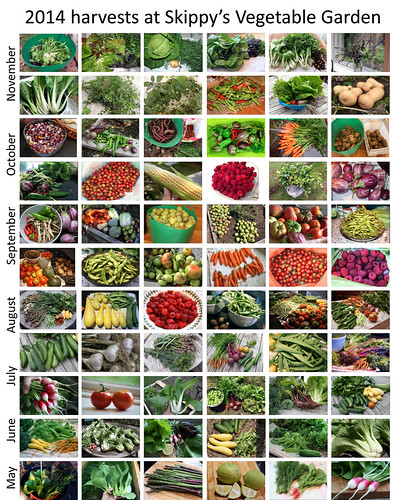
2014 harvests
What a year. Now I remember why I was busy! I love to look back and remember the harvests.
It was my first year to harvest a full meal of asparagus. My best year for bok choi, beans, eggplants and cucumbers. And a fantastic year for popcorn and pears. The potatoes, peppers, squash and raspberries were good. I wonder what 2015 will bring.
how to grow "comically huge" onions
I was so thrilled with Sara's comment on how to grow "comically huge" onions that I have spent some time reading up on onion culture.

Here's a really great link I found: Growing Onions, TexasA&M
Sooo.... My plan is: plant shallow, then baby my onions until the end of May. Lots of food and water and sun.
Onion varieties I'm growing this year: Pontiac, White wing, Red wing, and Ailsa Craig.
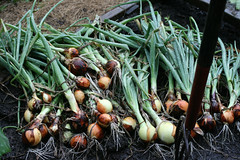
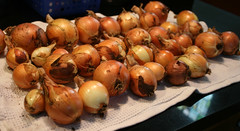
Sara wrote: Onions: plant very shallowly, feed, feed, feed and water to put on as much leaf mass as possible before your daylength reaches the # of hours that your variety requires to bulb. Used organic fertilizer and compost last year and grew HUGE onions. Comically huge.These are my tiny onions:

Here's a really great link I found: Growing Onions, TexasA&M
The size of the onion bulb is dependent upon the number and size of the green leaves or tops at the time of bulb maturity. For each leaf there will be a ring of onion; the larger the leaf, the larger the ring will be.My onion varieties are all "long-day" onion varieties. They will quit forming tops and begin to form bulbs when the day length reaches 14 to 16 hours. In the Boston area, that happens (15 hours) on May 29. (I used this daylight calculator.)
Sooo.... My plan is: plant shallow, then baby my onions until the end of May. Lots of food and water and sun.
Onion varieties I'm growing this year: Pontiac, White wing, Red wing, and Ailsa Craig.
Wednesday, 14 January 2015
new year's vegetable garden resolutions
1. More lettuce. I say this every year. I get a good spring crop then get distracted with all the other plants and forget the succession planting. Lettuce and other salad greens are something we eat a lot of.
2. Also more beets, carrot, garlic, onions. And less winter squash.
3. Grow beautiful tomatoes, which means solving the problem I had with bad compost. I'll move them to a bed that didn't get the bad stuff. I hope some of my home compost is ready this spring.
4. Grow bigger onions. I gave some of my seedlings to a friend who is a fantastic gardener and she grew onions 3 times as big as mine - from the same seedlings. OK she's not all organic. But I can do better by giving them more space and not letting other plants shade them. I wonder how much inconsistent irrigation affects onions.
5. Consistent crops of bok choi and broccoli. I did all-or-nothing, feast-or-famine, with these last year. There must be a way to have a few ready all the time.
6. Try again for a good crop of winter greens in a plastic tunnel, i.e. get rid of the voles.
7. I want to find a good vantage point to photograph my garden more and keep up with monthly photos. Sometimes I forget just how beautiful a garden is and how wonderful the summer season was. I just love to look back at the photos in the middle of winter. And I love to share the pictures.
8. Enjoy my garden more this year. I've certainly enjoyed it every year in the past, but I would look forward to the challenge of enjoying it even more!
I'd love to hear other gardeners' New Year's resolutions!
2. Also more beets, carrot, garlic, onions. And less winter squash.
3. Grow beautiful tomatoes, which means solving the problem I had with bad compost. I'll move them to a bed that didn't get the bad stuff. I hope some of my home compost is ready this spring.
4. Grow bigger onions. I gave some of my seedlings to a friend who is a fantastic gardener and she grew onions 3 times as big as mine - from the same seedlings. OK she's not all organic. But I can do better by giving them more space and not letting other plants shade them. I wonder how much inconsistent irrigation affects onions.
5. Consistent crops of bok choi and broccoli. I did all-or-nothing, feast-or-famine, with these last year. There must be a way to have a few ready all the time.
6. Try again for a good crop of winter greens in a plastic tunnel, i.e. get rid of the voles.
7. I want to find a good vantage point to photograph my garden more and keep up with monthly photos. Sometimes I forget just how beautiful a garden is and how wonderful the summer season was. I just love to look back at the photos in the middle of winter. And I love to share the pictures.
8. Enjoy my garden more this year. I've certainly enjoyed it every year in the past, but I would look forward to the challenge of enjoying it even more!
I'd love to hear other gardeners' New Year's resolutions!
the first year in skippy's new vegetable garden
Tuesday, 13 January 2015
herb salts
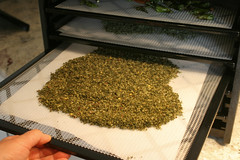
Back in early November, I made several herb salts. I looked up several recipes and found that these mixes can be either mostly herb with a bit of salt for flavoring or mostly salt with a bit of herb flavoring. At first I used a recipe for the former: mostly herb. That didn't seem the most useful for me, so I added salt.
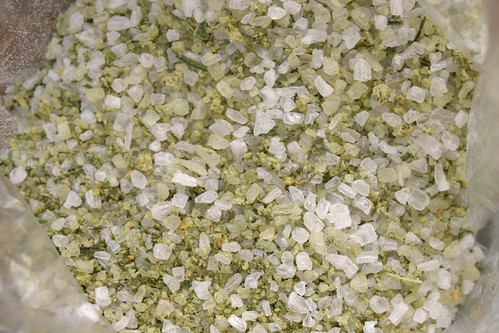
My mixes ended up with about equal amounts of salt and herbs. I use them whenever I would be normally be adding plain salt to a recipe - and I get some extra flavor. I sprinkle the sage salt on cooked carrots, the thyme salt on broccoli, rosemary salts on scrambled eggs. Very nice.


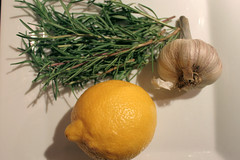
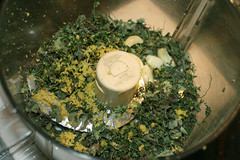
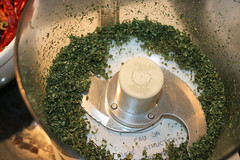
To make the salts, I combined all ingredients listed below, processed in food processor til smooth, then spread on a sheet of the plastic mesh that came with my dehydrator with a sheet of parchment below and anther plastic mesh below those. I dried at low heat (110*F) in dehydrator for a few hours. When dry, I pushed the mix through the mesh onto the parchment and stored in plastic bags.
As I mentioned above, I added salt to get the flavor I preferred. I ended up with equal amounts of salt and herbs, 1:1 ratio. Many recipes call for a 1:4 ratio of salt to herbs.
Rosemary salt
Fresh rosemary
Lemon zest
Garlic cloves, crushed
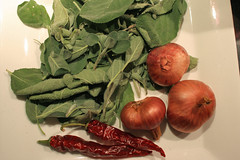
Sage salt
Fresh sage leaves
Shallots, chopped
Dried chiles
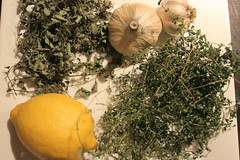
Thyme salt
Fresh thyme, stems removed
Fresh oregano, stems removed
Lemon zest
Garlic cloves, crushed


I gave several of the salts away as Christmas gifts to my siblings. Now that I've posted this I can send a link and show them how I made them.
My mixes ended up with about equal amounts of salt and herbs. I use them whenever I would be normally be adding plain salt to a recipe - and I get some extra flavor. I sprinkle the sage salt on cooked carrots, the thyme salt on broccoli, rosemary salts on scrambled eggs. Very nice.


To make the salts, I combined all ingredients listed below, processed in food processor til smooth, then spread on a sheet of the plastic mesh that came with my dehydrator with a sheet of parchment below and anther plastic mesh below those. I dried at low heat (110*F) in dehydrator for a few hours. When dry, I pushed the mix through the mesh onto the parchment and stored in plastic bags. As I mentioned above, I added salt to get the flavor I preferred. I ended up with equal amounts of salt and herbs, 1:1 ratio. Many recipes call for a 1:4 ratio of salt to herbs.
Rosemary salt
Fresh rosemary
Lemon zest
Garlic cloves, crushed
Sage salt
Fresh sage leaves
Shallots, chopped
Dried chiles
Thyme salt
Fresh thyme, stems removed
Fresh oregano, stems removed
Lemon zest
Garlic cloves, crushed


I gave several of the salts away as Christmas gifts to my siblings. Now that I've posted this I can send a link and show them how I made them.
Monday, 12 January 2015
Sunday, 11 January 2015
Subscribe to:
Comments (Atom)